Gratitude: Self-Care Journal
- 4.9
- Rating
- 5.00M
- Installs
- Free
- Price

 Analysis by App-foxy
I tried Gratitude: Self-Care Journal as a simple daily space for noticing what is going well, and I found its appeal fairly easy to understand: it encourages a small pause rather than asking you to build an elaborate productivity system. It is a free lifestyle app from Hapjoy Technologies, centered on gratitude journaling, affirmations, and vision boards. That combination makes it more flexible than a plain notes app, although it also means the experience is shaped around positive reflection rather than open-ended journaling.
The app has been available since March 29, 2018, and its current version is 7.2.3 for devices running Android 8.0 or later. It is rated for Everyone, which fits the gentle, general-purpose approach. The store summary describes daily inner peace through gratitude journaling, affirmations, and vision boards; in practice, I see it as a guided self-care companion rather than a replacement for therapy, a private diary with advanced organization, or a serious goal-management tool.
How the free experience and paid value fit together
The most important buying detail is straightforward: the app is free to install. It also includes in-app purchases priced from $3.99 to $59.99 per item. That range matters because “free” describes access to the app, not necessarily every part of the experience. I would begin without paying and spend several days checking whether the writing habit, affirmations, and visual planning tools genuinely fit my routine before considering an upgrade.
You May Also Like

 Blood Strike: 2.5 Anniversary
Blood Strike’s Loadouts Turn Every Drop Into a Tactical Gamble
A close look at Blood Strike’s custom loadouts: how fast access to signature weapons reshapes its battle royale rhythm, rewards preparation, and narrows the gap between fights.

 Pandora - Music & Podcasts
Pandora’s Music Is Easy to Start, but Harder to Recover
Pandora’s strength is its low-effort path from a seed to a station. Its weak spot is how much confidence it asks you to place in connection, setup, and quiet recovery.

 8 Ball Pool
 Is Built on Rivalries, Rematches, and Routine
A close look at the rivalries, rematches, shared routines, and unanswered safety questions that turn a quick pool match into a persistent mobile community.

 Samsung Music
’s Quiet Strength Is Playing What You Already Own
Its reach comes less from spectacle than from dependable access to a personal library. That simplicity is both the app’s strongest retention engine and its ceiling.

 AccuWeather: Weather Radar
AccuWeather Review: A Quick, Clear Forecast for Everyday Decisions
For everyday plans, the best forecast is the one you can understand quickly. AccuWeather makes rain timing, radar, and local conditions easy to act on, with a few trade-offs.

 Hill Climb Racing
Why Hill Climb Racing Still Turns Crashes Into One More Run
A tiny car, a bumpy hill and one more upgrade: Hill Climb Racing keeps resurfacing because its simple chaos makes every near-miss feel personal.
More From Our News Desk



I appreciate that this approach lets a new user test the basic idea without making an immediate commitment. For a lightweight journaling app, the first question is not whether it has a long feature list; it is whether I will actually open it when I am tired, distracted, or having an ordinary day. Free access gives you room to answer that honestly. If you only want a place to type a few lines, paying for extras may not improve the habit enough to justify the expense.
The paid side is more difficult to judge purely by price because the useful value depends on how deeply you use the app. Someone who enjoys building a visual board and returning to affirmations may see more benefit than someone who wants a blank page. I would treat purchases as optional convenience or enrichment, not as a requirement for getting started. That distinction keeps the decision practical: first prove that the routine works for you, then decide whether additional access adds something meaningful.
One detail I would keep in mind is the wide difference between the smallest and largest listed purchase. A higher-priced item deserves more scrutiny than a small one, especially if your goal is simply daily reflection. Before buying, I would read the exact description shown inside the app and ask whether it changes my regular workflow or merely adds more material. The best value here comes from consistent use, not from collecting every available option.
A calm design for short daily check-ins
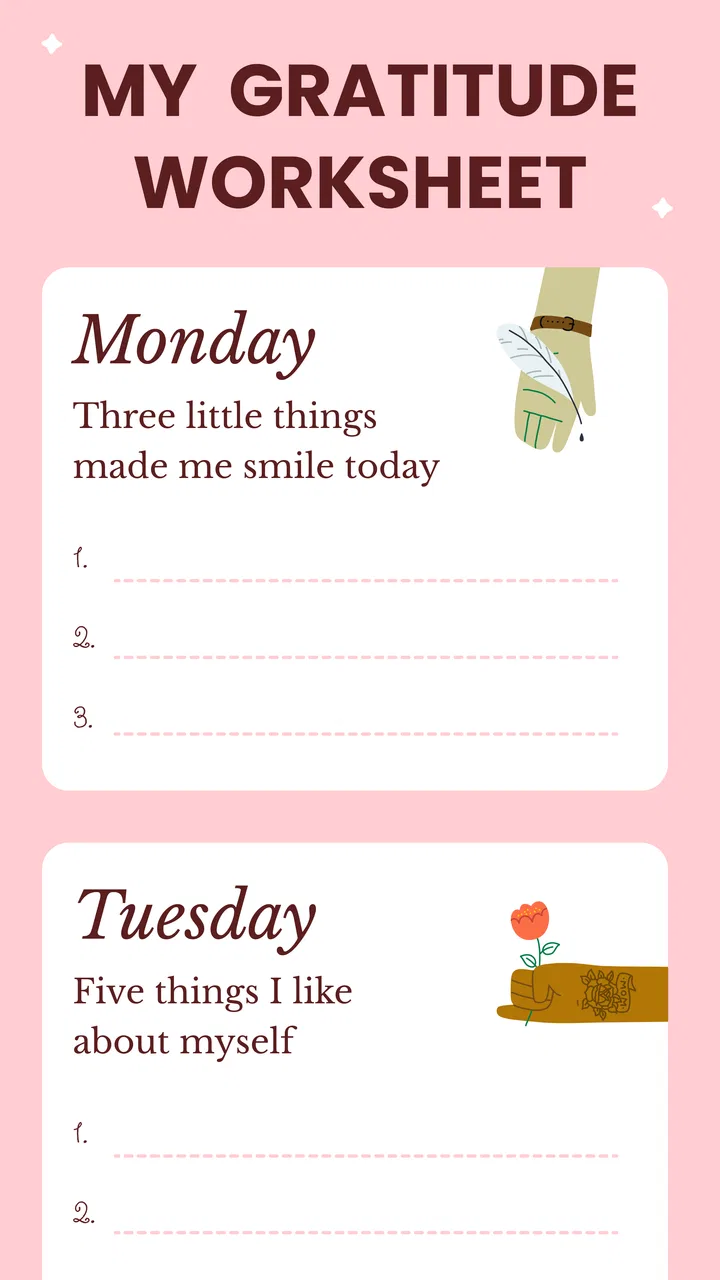
My preferred way to use this kind of app is to make the entry deliberately small. Rather than waiting for an inspiring event, I would record one ordinary detail: a quiet commute, a useful conversation, a meal I enjoyed, or the fact that I finished an unpleasant task. That keeps gratitude from becoming a performance. The app works best when it helps me notice something real instead of pressuring me to sound cheerful.
The journaling element is also useful as a transition between parts of the day. In the morning, I can use it to identify what I want to appreciate or carry into the day. At night, I can look back at a moment that went better than expected. These are different jobs, and separating them makes the practice less repetitive. A morning entry can be an intention; an evening entry can be evidence that the day contained more than its stressful parts.
Affirmations add a different tone. They are not the same as recording an event, because they ask me to repeat a supportive statement rather than document an experience. I find that distinction helpful when I am stuck: journaling can feel difficult when nothing seems worth writing, while a short affirmation can provide a starting point. At the same time, affirmations can feel forced if the wording is too far from what I believe. I would use them as prompts, not as a substitute for honest reflection.
The vision-board side gives the app a more visual direction than a conventional diary. I can imagine using it when my thoughts are scattered and I need to describe a desired atmosphere rather than a precise target. For example, a board about a calmer home life may be more motivating than a list of strict resolutions. The trade-off is that visual inspiration can become passive browsing. I would connect each board to one small action, such as clearing a desk, planning a walk, or setting aside time for a hobby, so it remains useful beyond decoration.
Three workflows that make the app more useful
My first practical workflow would be the “one fact, one feeling, one next step” entry. I would write one thing that happened, name how it affected me, and finish with a small action for tomorrow. This prevents the journal from becoming a collection of disconnected compliments. It also makes the app more useful on difficult days, because the entry can acknowledge frustration while still identifying one manageable next move.
My second workflow would be to keep affirmations separate from evidence. If I choose a supportive statement, I would follow it with a concrete example from my own life. For instance, instead of repeating a broad claim about confidence, I might note that I asked a necessary question during a meeting. This makes the exercise feel less artificial and turns the app into a record of gradual progress rather than a stream of slogans.
My third workflow would be to review a vision board before writing, then deliberately add something unrelated to the board in the journal. That small separation matters. It stops the visual goals from narrowing my attention to achievement and leaves room for relationships, health, rest, or simple pleasures. In my view, this is where the three parts work best together: the board points toward a direction, the affirmation supports the mindset, and the journal keeps the experience grounded in daily life.
Another useful habit is to write at a fixed transition point instead of relying on motivation. I would attach the check-in to brushing my teeth, making tea, or settling into bed. The goal is not a long session. It is to make opening the app as automatic as the routine already surrounding it. This matters more than writing impressive entries, because a self-care tool has limited value if it remains untouched after the first enthusiastic week.
Where it differs from ordinary alternatives
A standard notes app gives me complete freedom, which is its greatest strength. I can write anything, organize it any way I like, and avoid prompts that do not suit me. Gratitude: Self-Care Journal is more focused. That focus can help when a blank page feels intimidating, but it may feel restrictive if I want to record detailed travel notes, long personal reflections, work logs, or complicated ideas in the same place.
A paper notebook offers a slower, more tactile experience and does not invite screen distractions. It can also feel more private simply because it is not another app on a phone. The digital option is easier to keep with me and better suited to a quick entry, an affirmation, or a visual board. I would choose paper when handwriting itself helps me think, and this app when convenience and guided prompts are more likely to keep me consistent.
Compared with a meditation app, this one is more active and reflective. Meditation usually asks me to observe the present moment without producing much written material. Here, I am encouraged to capture words, supportive ideas, and images. That makes it a better fit for someone who processes thoughts by writing or visualizing. If I mainly want breathing exercises, timers, or guided audio, I would look elsewhere rather than expecting this app to serve that purpose.
It also differs from a dedicated goal tracker. A goal tracker is usually strongest when I need deadlines, measurable milestones, reminders, or task status. This app appears better suited to the emotional side of change: why a goal matters, what kind of life I am imagining, and what I can appreciate along the way. I would pair the two only if I truly needed both; otherwise, using a goal app for goals and this one for reflection avoids forcing one tool to do the other’s job.
Real-life use, privacy expectations, and everyday friction
Imagine coming home after a demanding workday and feeling that the entire evening was a failure because one conversation went badly. I would open the journal and write three lines: what happened, what still went right, and what I want to do differently tomorrow. Then I might read an affirmation that feels believable rather than overly positive. A vision board could wait until the weekend, when I have enough attention to use it intentionally. This scenario shows the app’s strongest role: not erasing a bad day, but helping me describe it more fairly.
Another realistic use is during a period of change, such as starting a course, moving into a new home, or trying to rebuild a social routine. A vision board can hold the broader picture, while short entries capture small signs of movement that are easy to overlook. I would avoid turning every entry into a progress report. The app becomes warmer and more sustainable when it includes appreciation for support, rest, and unexpected moments instead of only tracking whether I reached a target.
The main friction is that positive reflection can become repetitive. If I write the same type of entry every day, the practice may start to feel like a chore. My solution would be to rotate the focus: one day notice a person, another day notice a place, then a skill, a choice, a sensory detail, or a problem that taught me something. This keeps the journal specific without needing longer sessions.
I would also be careful about using affirmations to dismiss genuine problems. If I am dealing with grief, anxiety, conflict, or a serious mental-health concern, a cheerful prompt may not be enough and could feel invalidating. The app can support a personal routine, but it should not be treated as professional care. Someone who needs structured clinical guidance, crisis support, or detailed symptom tracking should choose a more appropriate resource and seek qualified help.
Because this is a personal journal, I would review the app’s privacy information and device settings before entering anything highly sensitive. I would also avoid writing passwords, financial details, or information about another person that I would not want exposed. That is sensible with any digital diary. The convenience of having reflections on a phone should be balanced with care about what I choose to store there.
Who is likely to get the most from it?
I think the app is a good match for someone who wants a gentle daily ritual but does not know how to begin. The combination of journaling, affirmations, and vision boards offers several entry points. On a thoughtful day, I can write. On a low-energy day, I can use a short prompt or affirmation. When I am planning a broader change, I can think visually. That flexibility is more useful than a single rigid exercise.
It may also suit people who respond better to encouragement than to productivity pressure. A task list can make a busy person feel even more behind, while a gratitude entry asks for attention rather than achievement. I would especially recommend trying it to someone who wants to build a reflection habit in small steps and is comfortable with a positive, self-care-oriented tone.
I would be less likely to recommend it to a person seeking a completely blank, highly customizable diary. The built-in direction is part of its identity, and that will not appeal to everyone. It is also not my first choice for detailed project planning, habit analytics, long-form writing, or meditation instruction. In those cases, a notes app, a dedicated planner, or a meditation service would probably offer a better fit.
Families may appreciate the Everyone age rating, but I would still encourage younger users to understand that a journal is personal and digital entries should be written thoughtfully. Adults who share devices should use ordinary device security and consider what appears in notifications or recent-app screens. These are small practical considerations, yet they can determine whether a self-care routine feels comfortable enough to maintain.
What the community response suggests
The app has an average rating of 4.9 from around 169 thousand ratings, with roughly 8.9 thousand written reviews and more than 5 million installs. Those figures indicate that the concept has reached a substantial audience and that many users respond positively to its approach. I would still avoid treating popularity as proof that it will suit me. A highly rated guided journal can remain wrong for someone who dislikes affirmations or prefers an entirely open writing space.
What I take from that level of adoption is reassurance that this is not an obscure experiment I would install without context. Hapjoy Technologies has kept the app available across several years, and the current release supports a relatively broad range of Android devices beginning with Android 8.0. That makes it easier to try on an older compatible phone, though the experience will still depend on how well the app’s style matches my habits.
My buy-or-skip verdict
I would try Gratitude: Self-Care Journal if I wanted a free starting point for a short, positive daily check-in and liked the idea of combining written gratitude with affirmations and visual planning. The free entry point lowers the risk, and the three-part format gives me more ways to continue when one method becomes stale. I would use it as a modest daily ritual, not as a complete personal-development system.
I would skip it if I wanted advanced organization, a neutral blank diary, meditation sessions, or measurable goal management. I would also skip paid extras until the free routine had proved itself in real life. The purchase range makes it especially important to judge value by repeated use rather than curiosity. If I am not opening the app after a week, adding more content will not solve the underlying problem.
My final view is favorable but specific: this is best for a person who wants encouragement, structure, and a visual way to think about everyday wellbeing. Its strongest feature is not any single prompt; it is the choice between several small forms of reflection. Used honestly and briefly, it can make a busy day feel more noticed. Used as forced positivity or as a substitute for proper support, it loses its value. For the right user, I think the free experience is worth trying before making any decision about in-app purchases.
FAQs for Gratitude: Self-Care Journal
01What is Gratitude: Self-Care Journal, and what can I use it for?
Gratitude: Self-Care Journal is a wellness and journaling app designed to help you build a more positive daily routine. You can use it to record things you appreciate, write personal reflections, create affirmations, set intentions, and review your progress over time. It is suitable for short daily entries or longer private reflections when you want to focus on mindfulness and emotional well-being.
02Is Gratitude: Self-Care Journal suitable for beginners who have never kept a journal?
Yes. The app is approachable for beginners because it offers guided prompts and simple journaling activities rather than requiring you to know how to write structured diary entries. You can start with a few sentences, answer a prompt, or simply list positive moments from your day. The flexible format also makes it useful for experienced journal users who want additional inspiration.
03Does Gratitude: Self-Care Journal include reminders or guided self-care activities?
The app is built around creating a consistent self-care habit and may provide tools such as journaling reminders, gratitude prompts, affirmations, and other guided exercises, depending on the version and platform. These features can make it easier to return to your journal regularly. Before downloading, check the current store listing to confirm which activities and reminder options are included.
04Is my personal journal information private and secure?
Because journal entries can contain sensitive thoughts and personal information, privacy should be considered before using any journaling app. Gratitude: Self-Care Journal may offer privacy-related features such as app protection or account controls, but available options can vary by device, subscription, and app version. Review the app’s privacy policy and store permissions, and use any passcode or biometric lock available.
05Is Gratitude: Self-Care Journal free to download, or does it require payment?
The app may be available as a free download while offering optional premium features through subscriptions or in-app purchases. Paid benefits can include additional prompts, themes, exercises, customization options, or expanded journaling tools. Pricing and trial terms may differ between Android and iOS and can change over time, so review the relevant app-store page carefully before confirming a purchase.
Pros
- Simple prompts make daily gratitude journaling easy to maintain.
- Mood tracking helps reveal emotional patterns over time.
- Private journal entries support personal reflection without social pressure.
- Custom reminders encourage consistent self-care habits.
- Clean design makes navigation comfortable for beginners.]
- contras:[
- Some useful features may require a premium subscription.
- Daily prompts can feel repetitive after extended use.
- Limited customization may not suit users wanting a flexible journal.
- Emotional insights depend on entering entries consistently.
- Users seeking therapy or crisis support need a dedicated professional service.
Cons
- Some useful features may require a premium subscription.
- Daily prompts can feel repetitive after extended use.
- Limited customization may not suit users wanting a flexible journal.
- Emotional insights depend on entering entries consistently.
- Users seeking therapy or crisis support need a dedicated professional service.

Gratitude: Self-Care Journal
Gallery